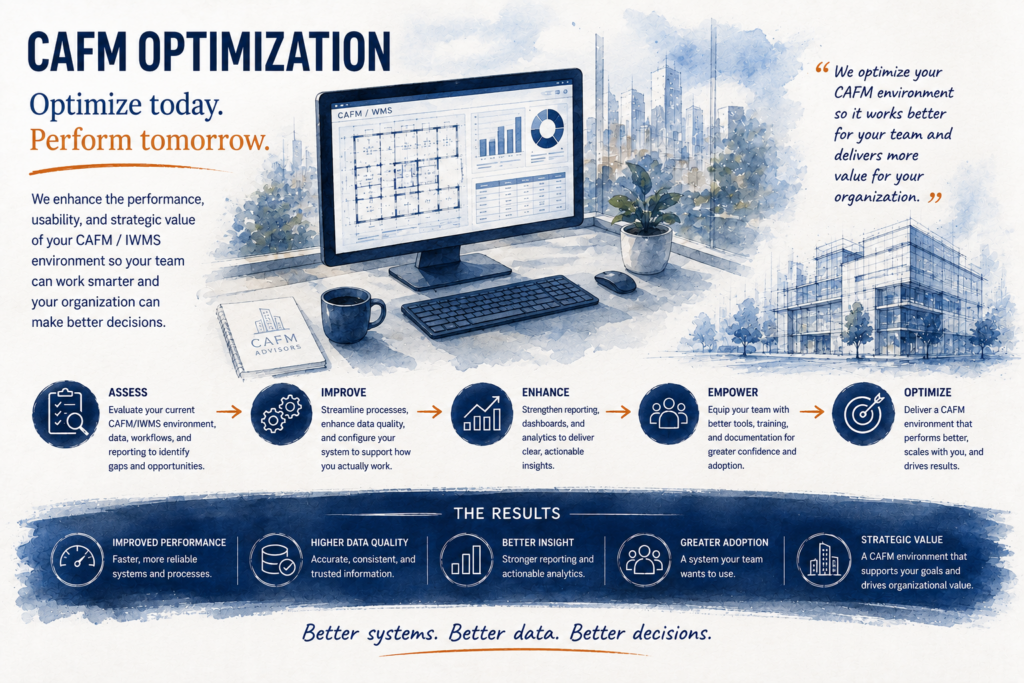
Modern facility management depends on more than floor plans and occupancy counts. Organizations today are expected to manage increasingly complex workplace environments while supporting operational efficiency, accurate reporting, strategic planning, and evolving workplace strategies. CAFM optimization is the process of improving the reliability, usability, and operational value of workplace data so organizations can make smarter decisions with greater confidence.
Accurate Data
Every successful CAFM/IWMS environment begins with accurate data. Clean CAD drawings, reliable space information, consistent standards, and governed data structures form the operational foundation that organizations rely upon for reporting, occupancy tracking, utilization analysis, and planning. When workplace data becomes outdated, inconsistent, or poorly managed, organizations quickly lose confidence in the information being used to support operational and strategic decisions.
Accurate data improves visibility across the built environment and allows facility teams to work from a centralized source of truth. From space allocations and departmental planning to lease management and emergency preparedness, reliable information is essential for maintaining operational consistency and reducing long-term inefficiencies.
Operational Insight
CAFM systems generate large amounts of workplace and occupancy data, but data alone has limited value without proper interpretation. CAFM optimization helps transform raw workplace information into actionable operational insight that supports better planning and more informed decision-making. By analyzing utilization trends, occupancy metrics, reporting structures, and workflow performance, organizations gain a clearer understanding of how their facilities support business operations.
This operational visibility allows leadership teams to identify inefficiencies, uncover underused space, improve reporting accuracy, and better align workplace strategies with organizational goals. Reliable operational insight creates the foundation for smarter facility management and more proactive decision-making.
Improved Efficiency
Disconnected systems, inconsistent workflows, and poorly governed data can create operational friction across facility management environments. CAFM optimization focuses on improving system usability, streamlining processes, and reducing inefficiencies that slow down operations or create reporting inconsistencies. Standardized workflows and cleaner data structures help organizations improve coordination between departments while reducing time spent correcting errors or reconciling conflicting information.
Efficient CAFM environments also improve scalability. As organizations grow, evolve, or adapt to changing workplace strategies, optimized systems provide the flexibility needed to support long-term operational demands without sacrificing data reliability or reporting quality.
Strategic Impact
The value of CAFM extends far beyond daily operational support. Reliable workplace data plays a critical role in broader organizational strategy, including real estate planning, portfolio management, workplace modernization, utilization strategy, and cost optimization. Organizations that invest in CAFM optimization are better positioned to support executive decision-making with accurate, actionable information.
Strategic CAFM environments help leadership teams move beyond reactive facility management and toward proactive operational planning. When workplace data is trusted, organizations can make decisions with greater confidence regarding space utilization, consolidation opportunities, staffing needs, and long-term workplace strategy.
Why CAFM Optimization Matters
CAFM optimization is ultimately about creating operational clarity. Reliable data, governed standards, and efficient workflows allow organizations to better understand the physical environments that support their business operations. As workplace expectations continue to evolve and operational complexity increases, organizations that invest in clean data, operational insight, and strategic workplace intelligence will be far better equipped to adapt, grow, and make informed decisions for the future.